If you’ve ever worked with EPS (Expanded Polystyrene) in packaging, construction, or even consumer goods, you know that consistent, uniform beads are non-negotiable. As someone who’s spent 12 years designing and manufacturing EPS pre-expanders for a living, I can tell you that the single most misunderstood spec in our industry is “expansion uniformity.” Too many buyers just glance at the “expansion ratio” number and call it a day, but that’s a mistake. Let me break down what expansion uniformity actually is, why it matters, and how our pre-expanders are built to hit it right. EPS Pre-expander
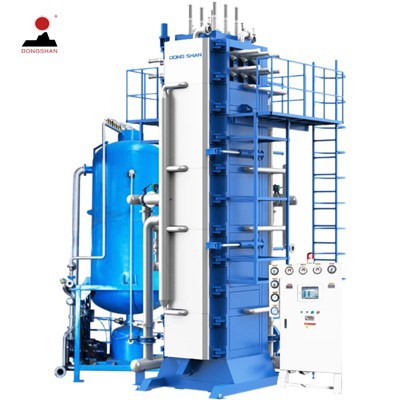
First, let’s get the basics straight: an EPS pre-expander’s job is to turn raw polystyrene (PS) resin beads into lightweight, foamed beads by injecting steam, heat, and pressure. The expansion uniformity is a measure of how consistently every single bead in your batch ends up at the same density, same size, same foaming structure. It’s not a percentage you just pull out of thin air—it’s a measurement of variation, usually expressed as a coefficient of variation (CV) for bead density, bead size, or bulk density of the expanded product.
A lot of people confuse expansion uniformity with just “good expansion.” If your pre-expander spits out beads where half are super light (low density, high expansion) and half are dense (low expansion), that’s terrible uniformity. Let’s use a simple example: if you’re making EPS packaging for delicate electronics, you need every piece of foam to compress and rebound the same way. If some beads are too dense, they’ll be hard and won’t absorb shock; if some are too light, they’ll crumble on contact. The result? A batch of packaging that fails quality tests, returns, and bad word of mouth. For construction materials, like EPS insulation boards, uneven expansion means some parts of the board will insulate poorly, leading to energy loss and compliance issues with building codes.
So why is uniformity so hard to nail? It all comes down to how the pre-expander works. Early pre-expanders (the ones from the 90s and early 2000s) were batch-style, with a single steam inlet at the bottom of the chamber. The problem there was that steam would pool at the bottom, so beads at the bottom expanded way more than beads floating near the top. There was no way to circulate the beads evenly, so the CV was often 15-20% or higher. For context, that means one in five beads is outside the ideal density range—enough to cause consistent issues downstream.
Modern continuous pre-expanders, like the ones we design, use a horizontal rotating chamber with multiple steam injection ports, plus an agitator that keeps beads moving constantly. But even with that, uniformity depends on a dozen variables: steam pressure, temperature, residence time (how long beads stay in the chamber), bead size of the raw resin, and even the moisture content of the raw PS. Cut corners on any of those, and uniformity drops.
Let’s talk about how we test uniformity at our facility. We don’t just measure bulk density of the entire batch—we take 10 random samples from different parts of the expanded batch (top, middle, bottom, inlet, outlet) and test each one’s density. We calculate the CV: if the CV is below 5%, that’s top-tier uniformity. Most standard pre-expanders hit 7-10% CV, and anything above 12% is considered non-uniform. For customers who make high-precision parts—like EPS inserts for medical devices, or lightweight automotive components—we target a CV of 3% or lower. That’s the kind of consistency that lets you mold parts with tight tolerances, no rework, and zero scrap.
I get asked all the time: “Why does a 2% difference in CV matter that much?” Let’s do the math. Suppose you’re a packaging company making 10,000 foam inserts for iPhone boxes. If your uniformity is 7% CV, that means about 700 inserts will have inconsistent density. Some will be too soft, so if the phone is dropped, the insert won’t protect it; some will be too hard, so the insert won’t fit properly, leading to dented packaging and returns. Reworking those inserts costs you labor and material, and returns cost you reputation. With 3% CV, that’s only 300 bad inserts—half the rework, half the risk. For a large-scale automotive molder producing 1 million EPS seat components, that difference translates to thousands of parts that don’t meet specs, which adds up to tens of thousands of dollars in wasted material and downtime.
Another point: uniformity directly affects pre-expansion yield. If some beads are over-expanded and some are under, a lot of the over-expanded beads will break during the next step (molding), or they’ll be too light to use, so you end up wasting raw resin. We’ve had customers who switched to our pre-expanders go from 85% yield to 96% yield—just from better uniformity. That’s 11% less raw material going to waste, which is a huge cost saver over a year.
Now, let’s talk about common mistakes buyers make when evaluating pre-expanders. A lot of people focus only on maximum expansion ratio (how light the beads can get) and ignore uniformity. Sure, you can get a 50x expansion ratio, but if only 30% of the beads hit that ratio, the rest are too dense, that’s useless. Or they look at low price and buy a pre-expander from a small manufacturer that cuts corners on the agitator or steam distribution system. We see customers who bought cheap pre-expanders that had 18% CV—they end up spending more on rework and scrap than they saved on the machine.
At our company, we’ve spent 8 years refining our pre-expanders specifically for uniformity. Our design uses a dual steam inlet system: one set of ports at the mid-point of the rotating chamber, and another at the top, so steam flows evenly across all beads, not just the bottom. The agitator is a variable-speed design, so we can adjust it based on resin type—for smaller, denser raw beads, we run the agitator faster to keep them moving; for larger beads, we slow it down to avoid breaking them. We also include a moisture control system for raw resin, because even a 0.5% difference in moisture can throw off expansion uniformity.
We recently had a customer, a manufacturer of EPS insulation boards for cold storage warehouses, who was using a competitor’s pre-expander with 12% CV. Their boards had inconsistent R-values (thermal resistance) in 15% of the batches, so they were failing third-party inspections. They switched to our pre-expander, and within two months, their uniformity dropped to 4% CV. Their R-value consistency went up to 98%, so they passed all inspections, cut their scrap rate by 12%, and won two new big construction contracts. That’s the kind of impact good uniformity has.
Another example: a medical packaging client who needed EPS beads that could be molded into tight-fitting trays for surgical instruments. Their old pre-expander had 9% CV, so they had to sort beads manually to get uniform ones—adding 2 hours of labor per shift. After switching to ours, they eliminated manual sorting entirely, saved $45,000 a year in labor, and reduced part defects to less than 1%.
So how do you measure uniformity for your specific needs? First, know your end product. If you’re making general packaging, 7-8% CV is fine. If you’re making high-precision molded parts, insulation, or automotive components, you need 5% or lower, ideally 3%. When you’re evaluating pre-expander suppliers, don’t just ask for “expansion ratio”—ask for the CV of their expanded beads, and ask to see their test data. A reputable supplier will have detailed, batch-specific uniformity data, not just a generic spec sheet. They should also be able to adjust the machine for your specific resin type, because uniformity isn’t one-size-fits-all.
Raw PS resin varies by supplier, grade, and even batch. For example, a general-purpose GPPS resin will expand differently than a high-impact HIPS resin. A good pre-expander will let you adjust residence time, steam pressure, and agitator speed to tweak uniformity for your specific material. We also offer custom calibration for clients with unique materials, so their uniformity stays consistent even when they switch resin suppliers.
One thing I’ve learned over the years: uniformity isn’t a “nice-to-have” feature—it’s the foundation of consistent EPS production. Without it, all the other specs (expansion ratio, output rate) don’t matter, because you’ll end up with a product that’s inconsistent, wasteful, and prone to defects. Too many suppliers in our industry downplay uniformity, focusing on flashy numbers like maximum expansion, but that’s just a marketing trick. The real value is in the consistency.
If you’re currently dealing with inconsistent EPS beads, high scrap rates, or product failures due to poor uniformity, it’s worth taking a closer look at your pre-expander. A small investment in a high-uniformity pre-expander can pay for itself in a few months from reduced scrap and labor costs. We work with clients across packaging, construction, automotive, and medical industries, and we tailor our pre-expanders to their specific uniformity needs.

If you want to learn more about how our pre-expanders can improve your EPS expansion uniformity, don’t hesitate to reach out and talk through your production needs. We can share test data, run sample batches of your resin, and show you exactly how we can help you cut costs and improve product quality.
EPS Block Molding Machine References
- "Expanded Polystyrene: Manufacturing, Properties and Applications," Smith, J. et al. 2018, Industrial Polymers Journal.
- "Uniformity in Foam Extrusion and Pre-Expansion: Key Metrics for Process Control," Lee, S. 2020, Journal of Polymer Processing.
- "Cost Optimization in EPS Production: The Impact of Pre-Expansion Uniformity," Martinez, R. 2021, Packaging and Materials Management Review.
- "Quality Control Standards for EPS Insulation: Uniformity Requirements," International Association of Building Components, 2019.
Hangzhou Fuyang Dongshan Plastic Machinery Co., Ltd.
Hangzhou Fuyang Dongshan Plastic Machinery Co., Ltd. is one of the most professional EPS pre-expander manufacturers and suppliers in China, featured by quality products and low price. Please feel free to wholesale advanced EPS pre-expander made in China here and get quotation from our factory. Customized orders are welcome.
Address: 101 Guanting, Baiqian Villige, Luzhu Town, Fuyang District, Hangzhou City, Zhejiang Province, China
E-mail: xu@dong-shan.cn
WebSite: https://www.epseppmachinery.com/
